- Visit
-
- Program
-
-
 What Is (or Was) Architectural Theory?12. November – 13. November
-
-
-
- Education
-
-
Next Event
 After Work Führung: Too Hot – Heisse Städte, neue Wege28. October – 17:00After Work Führung: MORE IS NOW4. November – 17:00
-
-
-
- Collections
-
- The DAM
-


International High-Rise Award 2026/27: Projects from four continents in the final for the world’s best high-rise
The finalists of this year’s International High-Rise Award (IHA) have been determined. The jury selected five buildings from Asia, Europe, Australia and South America from a total of 30 nominated high-rise buildings from 12 countries.
In reaching its decision, the jury focused on recognising projects that will remain relevant for many years to come, despite the fact that planning for them had begun several years earlier.
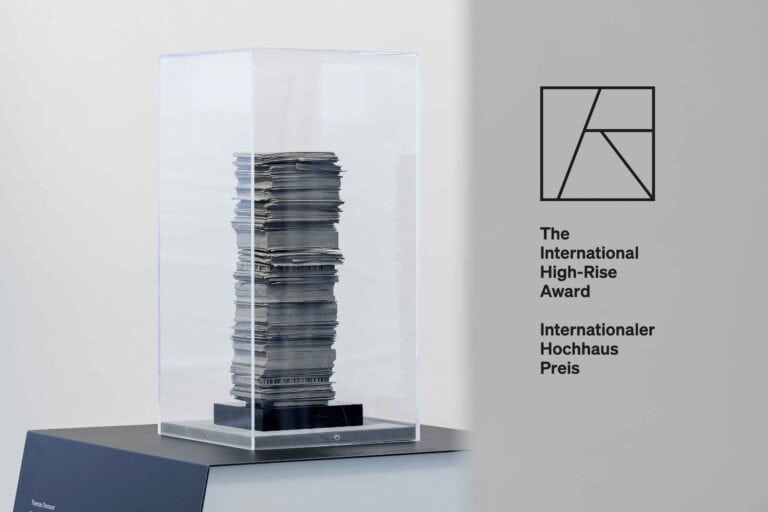
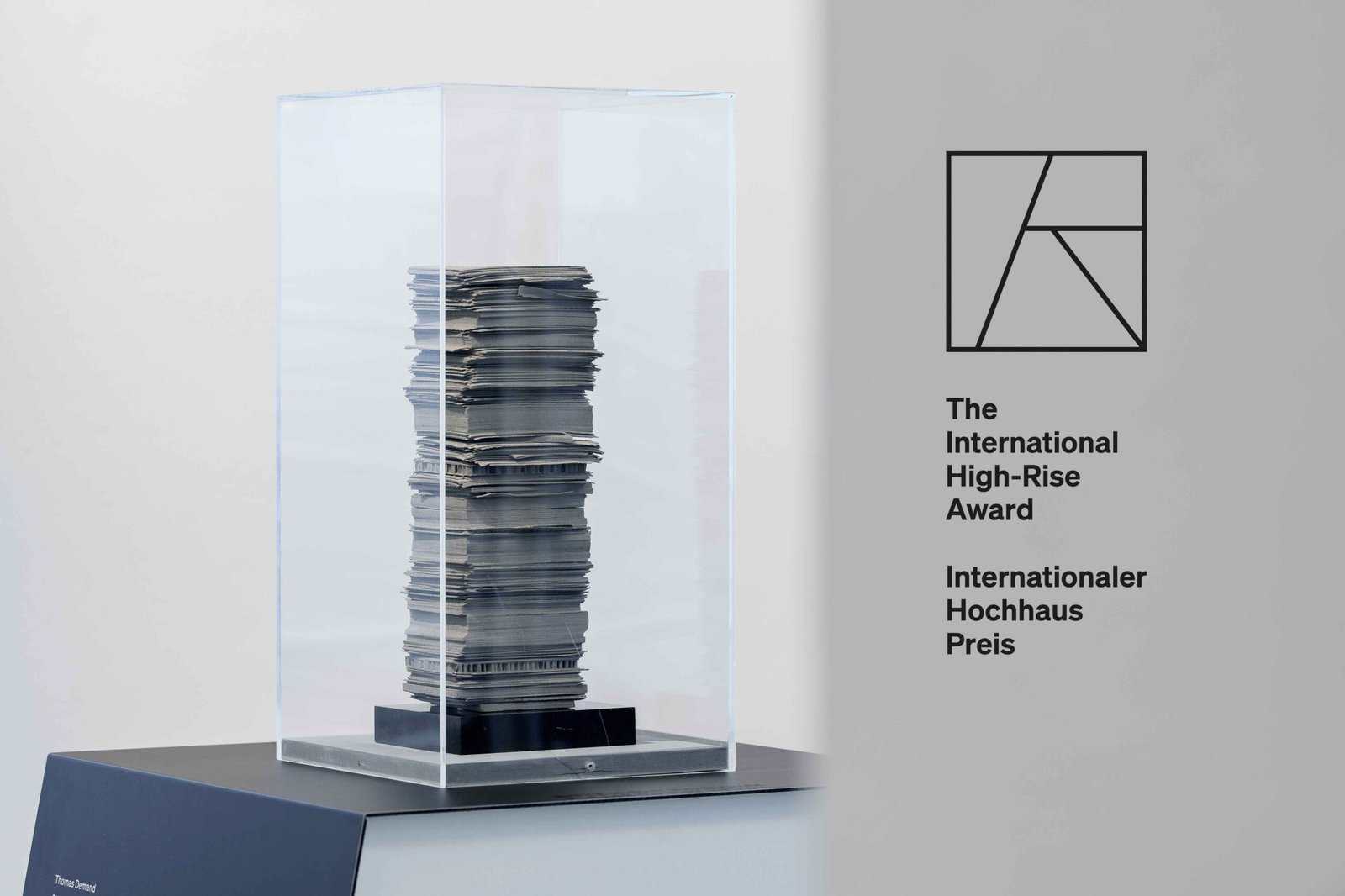
The IHA is regarded as the world’s most prestigious award for high-rise buildings. On 3 November 2026, Birgit Dietl-Benzin, a member of the DekaBank’s Executive Board, will announce the winning project at Frankfurt’s Paulskirche. The project will then be presented with a statuette by the internationally renowned artist Thomas Demand and a cash prize of 50,000 euros by Lord Mayor Mike Josef. In addition, the event will be broadcast via live stream. The award is presented by the City of Frankfurt am Main together with Deutsches Architekturmuseum (DAM) and DekaBank.
The IHA 2026/27 finalists at a glance
ZIN, Brussels, Belgium
Architecture: 51N4E, Brussels, Belgium; l’AUC, Paris, France & Jaspers-Eyers Architects, Brussels, Belgium
AGE 360, Curitiba, Brasilien
Architecture: Architects Office, São Paulo, Brazil & Triptyque, São Paulo, Brazil/ Paris, France
Tencent Tower, Guangzhou, China
Architecture: Ateliers Jean Nouvel, Paris, France
88 Walker, Sydney, Australia
Architecture: Fitzpatrick + Partners, Sydney, Australia
One Pearl Bank, Singapore
Architecture: Serie Architects, London, UK & Multiply Architects, Singapore
The International High-Rise Award is aimed at architects and developers whose buildings are at least 100 meters high and have been completed in the past two years. The jury evaluates the nominated projects with the criteria: future-oriented design, functionality, innovative building technology, integration into urban development schemes, sustainability and cost-effectiveness.
The IHA 2026/27 jury
The international jury is made up of experts from architecture and engineering practice, education and the partners of the IHA, namely DekaBank, the City of Frankfurt, and Deutsches Architekturmuseum.
Brian Yang, Partner BIG – Bjarke Ingels Group, Copenhagen/Denmark – jury chairman
Klaas De Rycke, Partner, Managing Director, Executive Board BOLLINGER+GROHMANN, Paris/France,
Elisabeth Endres, TU Braunschweig, Executive Management Ingenieurbüro Hausladen, Munich/Deutschland
Shirley Surya, Curator Design und Architecture, M+, Hong Kong
Martha Thorne, Architect, Curator, Author, Madrid/Spain
Florian Beck, Associate Partner, Site manager Munich blocher partners, Munich/Germany
Dr. Ina Hartwig, Deputy Mayor in Charge of Culture and Science City of Frankfurt / Main,
Peter Cachola Schmal, Director Deutsches Architekturmuseum (DAM), Frankfurt/Main
Johannes Hermanns, Managing Director Deka Immobilien Investment GmbH, Frankfurt/Main
Jury statements / About the finalists
For the jury, the focus was on the question of what role the high-rise of the future will play. It was agreed that – apart from aesthetics and function – the skyscraper’s ability to ‘be a good neighbour’ is of fundamental importance. Does it contribute to its surroundings and how does it enrich them? Does it benefit the city and its residents? Against this background, the jury – chaired by last year’s winner, Brian Yang – selected a shortlist of five finalists from among the 30 longlisted projects. Specifically, these are:
An exemplary transformation of 1970s high-rises (ZIN), a monolithic sculpture in which the structural framework and architecture are one (AGE360), a corporate headquarters with distinctive “sun roofs” that even sparkle at night (Tencent), a slender glass tower that seems to hover above a historic pub (88 Walker) and a residential high-rise that takes urban density to a new level (One Pearl Bank).
Whereas many of the high-rises in Brussels are classic glass-and-steel monoliths, ZIN breaks completely with the idea. The two original “World Trade Center” high-rises that stood here were stripped back to their core and redeveloped by embracing between them an intervening new structure with double heights, designed to encourage mixed use, both vertically and horizontally. Offices, residences, hotel rooms, retail, and green spaces are interwoven to create a coherent unit that is never “dead” at night.
The jury was impressed by AGE 360 in Brasil as an architectural eye-catcher. The tower is grounded in lush vegetation, bringing nature into the building. The overall result is a tower with integrated solar protection thanks to thick facades that functions like a vertical village. Excitingly and attractively done, it is an architectural sculpture. As Martha Thorne remarked, “So fitting for Curitiba. And the fact that the architectural elements solve more than one thing at a time is marvelous.”
Tencent Tower in China is a paramount example, the jury felt, of how to “unstack a vertical stack.” As Shirley Surya puts it, the high-rise morphs into a “complex stairwell edifice as if there were different houses divided across the four decks,” The tower, containing over 100,000 square meters of space and home not only to offices but also museums, movie theaters, and restaurants in the form of a genuine commercial street, “pushes the envelope,” as Surya says, of what a high-rise can be.
88 Walker consists of two very slender forms and yet stands on a very limited amount of space that includes the historic Firehouse Hotel pub in Sydney. From street level, the high-rise has a very restrained presence, as the beholder’s eye is in fact guided by the structural idea and how it is solved—the cantilevering over the old building that bears the load of the new. As jury member Florian Beck commented, “The architecture does not hide the project. The design shows its structure and reveals how the architects succeeded in designing their way round complexity.”
The consensus of the jury was that, whilst One Pearl Bank in Singapore took inspiration from the historic form of its predecessor, it does not simply imitate it. Instead, the project explores how community life can be improved. In this regard, the high-rise encourages a neighborly environment and is truly contemporary. The design attests to a thorough engagement with notions of social and public spaces in a very densely built city.
International High-Rise Award (IHA)
The International High-Rise Award was jointly initiated in 2004 by the City of Frankfurt, Deutsches Architekturmuseum (DAM) and DekaBank and has been organized in partnership since then. The IHA will be awarded for the twelfth time in 2026.
Previous recipients of the IHA
CapitaSpring, Singapore (2024)
Architecture: BIG-Bjarke Ingels Group &
CRA-Carlo Ratti Associati
Quay Quarter Tower, Sydney, Australia (2022)
Architecture: 3XN
Norra Tornen, Stockholm, Sweden (2020)
Architecture: Office for Metropolitan Architecture (OMA)
Torre Reforma, Mexiko City, Mexiko (2018)
Architecture: LBR&A Arquitectos
VIA 57 West, New York NY, USA (2016)
Architecture: BIG – Bjarke Ingels Group
Bosco Verticale, Milan, Italy (2014)
Architecture: Boeri Studio
1 Bligh Street, Sydney, Australia (2012)
Architecture: ingenhoven architects / Architectus
The Met, Bangkok, Thailand (2010)
Architecture: WOHA
Hearst Headquarters, New York NY, USA (2008)
Architecture: Foster + Partners
Torre Agbar, Barcelona, Spain (2006)
Architecture: Ateliers Jean Nouvel
De Hoftoren, Den Haag, Netherlands (2004)
Architecture: Kohn Pedersen Fox Associates
Media partner International High-Rise Award 2026/27: STYLEPARK
More information from: www.international-highrise-award.com